
London has more private members’ clubs than almost any other city in the world. From institutions that have been at the centre of the city’s social life for centuries to newer venues built around entirely different ideas of what membership should offer, there is now something for almost every taste and professional background.
Or you prefer rather to call? +41 22 900 11 28
This guide covers the clubs worth knowing about — what they are, what distinguishes them from each other and what to expect from the process of joining.
A private members’ club is a venue with a controlled membership that restricts access to those who have applied, been vetted and been accepted. Beyond that basic definition, the variation is considerable.
The oldest clubs in London trace their origins to the coffee houses of the seventeenth century, where merchants, politicians and writers gathered to exchange information and conduct business in a setting that offered more privacy than the street. White’s, generally considered the oldest surviving gentlemen’s club in the country, opened in St James’s in 1693. The model it established — a place where people of shared interests and social standing could meet in a relaxed, private setting — shaped the character of the London club scene for the following three centuries.
Today, the range is significantly broader. Some clubs maintain the classical model: formal settings, strict dress codes, lengthy waiting lists and a membership drawn from a relatively narrow social and professional circle. Others have reimagined what a members’ club can be — mixing co-working spaces with restaurants, wellness facilities with cultural programming, and building communities around shared values or professional interests rather than social background.
What all of them offer, in one form or another, is a degree of privacy and consistency that public venues cannot. A familiar space, a reliable standard, and a membership that provides a level of context for the people you are likely to encounter there.
5 Hertford Street is consistently described as London’s most discreet private members’ club — a description its founder, Robin Birley, would probably consider a compliment. Located in a Georgian townhouse in Mayfair, the club opened in 2012 and has attracted a membership that includes senior financiers, international business figures, politicians and a notable proportion of people who prefer not to be recognised. The interiors, designed by Rifat Ozbek, are deliberately domestic in feel — the effect is closer to a very well-appointed private house than a conventional club. Downstairs, the nightclub Loulou’s operates under the same discreet model.
Membership is invitation only. There are no published waiting list timelines.
Annabel’s was founded by Mark Birley in 1963 — originally as a nightclub, and one of the first London venues to admit both men and women on equal terms. Over the following six decades it became something considerably more than a nightclub: a social institution whose membership has included figures from the Rolling Stones and Princess Diana to successive generations of the British establishment.
The club relocated in 2018 to a new address on Berkeley Square, where it now occupies an entire Georgian townhouse. The interiors, designed by Martin Brudnizki, are deliberately opulent — a garden terrace, a series of distinctly decorated rooms and a nightclub in the basement. Membership costs approximately £3,250 per year with a £1,250 joining fee; under-35 memberships are available at reduced rates.

The Arts Club was founded in 1863 as a gathering place for those working in or seriously interested in the arts, literature and sciences. Its early membership included Charles Dickens, Franz Liszt and Auguste Rodin. Today it operates from a substantial premises on Dover Street and has evolved into a club that balances its cultural heritage with the interests of a membership drawn from across the creative, entrepreneurial and professional worlds.
The club maintains an active programme of exhibitions, talks and events, and its art collection is a genuine attraction in its own right. It is one of the more active clubs in terms of organised cultural programming, which distinguishes it from venues that primarily offer dining and social space.
Membership is by application and requires a proposer and seconder from among existing members.
The Garrick Club was founded in 1831 as a club for actors and those with a serious interest in the performing arts, and it has maintained that identity with considerable consistency. Its membership of approximately 1,500 includes actors, writers, lawyers, journalists, senior figures from the arts and judiciary, and members of both Houses of Parliament. Its collection of theatrical portraits and memorabilia is one of the finest private collections of its kind in the world.
Full membership costs approximately £7,500 to join with an annual fee of around £2,800.
The Garrick is a genuinely distinctive institution: less fashionable than the Mayfair clubs, more deeply embedded in a specific cultural tradition.
White’s is the oldest gentlemen’s club in London and among the most historic in the world. Founded in 1693 in St James’s, it has been a constant presence in the city’s social history and retains a membership that is drawn almost exclusively from the British aristocracy and establishment. It is, by design, one of the most difficult clubs to join — membership is by election and the waiting list extends for many years.
The past decade has seen a significant expansion in London’s members’ club landscape — driven partly by demand and partly by a broader shift in what people are looking for from membership. Several of the most interesting new entrants are built around ideas that would have been unfamiliar to the founders of the clubs above.
Soho House opened its first London location on Greek Street in 1995 with an explicit intention to create something different from the traditional club model: a space for people working in the creative industries that felt relaxed and contemporary rather than formal and hierarchical. It succeeded, and then some. There are now nine London locations, with a global network spanning more than 40 cities.
The clubs have well-designed spaces with excellent food, a strong events programme and a membership that reflects a genuinely international creative community. For professionals in the media, arts or technology industries, it remains a useful base in London.
Membership fees vary by type and location. Applications are reviewed by a committee on a rolling basis.
The Conduit was built around a specific mission: to bring together people who are working on social and environmental challenges, from entrepreneurs and investors to journalists, activists and policymakers. The programming reflects this — talks, forums and events that engage with substantive questions about the world — and the membership is genuinely diverse in background and nationality.
The club occupies eight floors in Covent Garden with a restaurant, event spaces, a bookshop and a rooftop terrace. The cooking, led by a kitchen committed to sustainable sourcing, is taken seriously. Membership costs £2,100 per year with a £475 joining fee; under-33 memberships are available at lower rates. Applications can be made online and are open to anyone, which is itself a departure from most of the clubs in this guide.
180 House is Soho House’s cultural flagship: nine floors within a former office building on the Strand, conceived as a space where art, creativity and membership overlap. The interiors reference the building’s 1970s heritage — leather bars, shag-pile rugs, lacquered surfaces — and the art programme, overseen by curator Kate Bryan, features more than 150 works throughout the building.
It operates within the wider Soho House membership framework and follows an identical application process. What distinguishes it from the other London Houses is the ambition of the cultural programming and the physical scale of the space.
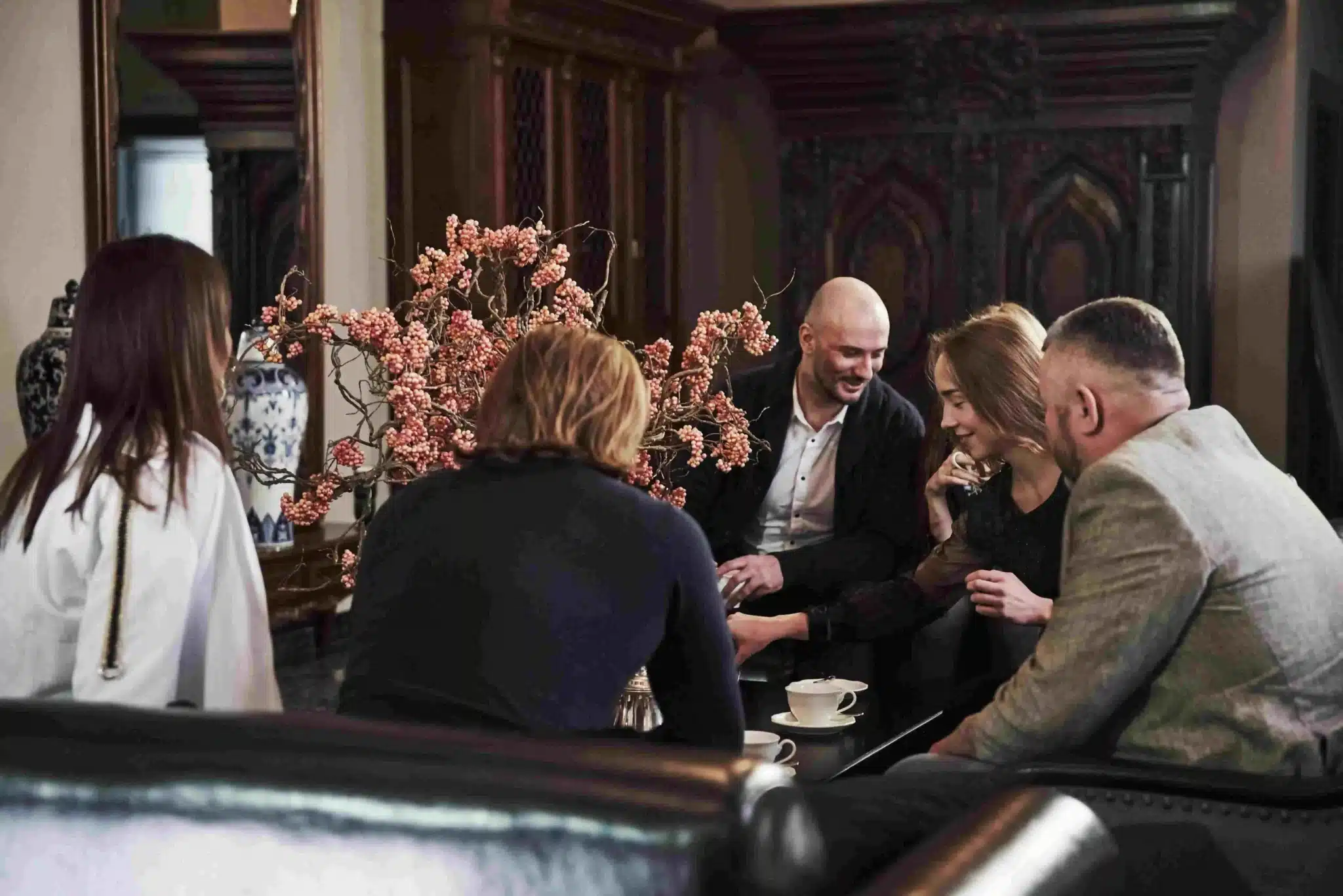
London is a city in which it is surprisingly difficult to meet people in a sustained, genuine way. The transience of the population, the density of options and the general pace of professional life all work against the kind of repeated, relaxed contact that tends to produce real connection.
Private members’ clubs change some of those conditions. The membership model means that the people you encounter share at least a degree of common ground — whether that is professional background, cultural interest or simply the fact that someone who knows you both thought it worthwhile to propose them. The physical space is designed for lingering rather than rushing. And the fact that members return regularly creates the conditions for the kind of repeated encounter that, over time, tends to produce something more than a brief acquaintance.
This does not mean clubs are designed as social introduction services — they are not. But for people who find that their professional lives have gradually narrowed their social world, or who are returning to London’s social scene after a period of focus elsewhere, a good members’ club can provide a context for meeting people that is considerably more conducive to genuine connection than most alternatives.
The right environment helps. But surroundings alone do not produce the kind of introduction that changes the direction of a person’s personal life.
At Macbeth Matchmaking, we work with London-based clients who are looking for exactly that: not a venue, but a person. Our process begins with a thorough, confidential conversation about who our clients are and what they are genuinely looking for. From there, we draw on an international network to make introductions that reflect a precise understanding of both people — not a proximity match, but a considered one.
London offers the setting. We offer the introduction. If you are ready to find someone worth spending time with in it, we would be glad to hear from you.
Get in touch — your search starts here.
The process varies significantly between clubs. At the more traditional end, membership is by invitation or election, requiring one or more existing members to propose you, and the decision-making process is entirely internal. At clubs like Soho House or The Conduit, applications can be made directly and are assessed by a committee, though Soho House’s London locations have effectively been closed to new members for periods due to capacity constraints.
Annual fees at London’s established clubs range considerably. Annabel’s costs approximately £3,250 per year with a £1,250 joining fee; 5 Hertford Street charges around £3,750 annually plus a £1,850 joining fee, with a reduced rate for under-35s; The Conduit is more accessible at £2,100 per year with a £475 joining fee; Soho House membership fees vary by type, from entry-level options that provide limited access to full memberships covering all Houses globally. These figures are indicative and subject to change. It is always worth checking directly with the club.
In practice, the terms are often used interchangeably. Strictly speaking, a members’ club is any club with a formal membership structure, while a private members’ club specifically limits access to members and their guests, excluding the general public. Most of the clubs described in this guide are private members’ clubs in the strict sense: you cannot walk in off the street, and entry without membership or a member’s guest invitation is not possible.
The answer depends on what kind of networking you have in mind. For professional connections in finance, law and the established British business world, the Mayfair clubs — particularly 5 Hertford Street and Annabel’s — provide a setting where senior figures from those worlds are regularly present. The Arts Club is more relevant for those whose professional world overlaps with culture, media and the arts. For the technology, creative and social impact sectors, The Conduit and Soho House have membership communities that reflect those industries. In all cases, the quality of networking in a members’ club tends to be a function of repeated presence over time rather than a single visit.
Most do, though the specifics vary. The traditional Mayfair clubs tend towards smart dress — jackets for men, equivalent standards for women — and some have detailed published dress codes covering specific areas of the club at specific times. Annabel’s encourages what it describes as “fabulous party dressing” for evening visits. Soho House operates a more relaxed standard in keeping with its creative membership, though trainers and sportswear are generally discouraged in dining areas. The Conduit has no formal dress code. When in doubt, it is always worth checking the club’s website or calling ahead.
Sources:
Individual club websites